Friday, July 1, 2016

July 2016 - Featured Playlist: Under the Big Top


We’re right in the thick of summer, and for many of us we’re reminded of childhood trips to the circus. As adults we see the overpriced popcorn, the rigged games, the countless forms of sugar, and the very questionable treatment of animals; but sometimes it’s good to whisk away to those innocent days when clowns were funny and not creepy, or when the mere sight of cotton candy didn’t make your shirt shrink.

Plenty of composers have written music inspired by circuses and carnivals, and luckily as adults we can still enjoy this guilt-free. So strap on the big red rubber nose and practice your sad-clown shuffle as you run away to join us Under the Big Top.

To hear the playlist, access NML as usual, go to the Playlists section, and select the Playlist of the Month folder under the Themed Playlists tab. If you are on your institution's premises, you may also be able to access it if you CLICK HERE.


1. Julius Fučík – The Entry of the Gladiators – Called the “Bohemian Sousa”, the magnificently mustachioed Julius Fučík was a prolific composer of military music, with many of his marches still performed in the Czech Republic today. His reputation in the West primarily rests on his earworm of a work The Entry of the Gladiators. Be grateful we didn’t put this one last on the playlist, or it would be marching through your head all day.

2. Karl King – Barnum and Bailey’s Favorite – Karl King was a largely self-taught musician who made his name composing band music. In many ways he did for the circus march what John Philip Sousa did for the military march. He was active in music education as well; while his compositions were typically at a very high technical level, he also contributed much to the school band repertoire at every level.


3. Cy Coleman – Barnum: Act II. Join the Circus – Cy Coleman was a prominent songwriter and Broadway composer throughout the twentieth century, and his hit musical Barnum was premiered in 1980. It ran for 854 performances and earned its composer a Tony Award nomination for Best Original Score.


4. Mark “Moose” Charlap – Clown Around: Animal Band – Moose Charlap’s final Broadway show suffered a quick demise thanks to ballooning production costs, and its soundtrack was long a true rarity, with beat-up vinyl copies reaching three figures on eBay. At last the soundtrack has been reissued, and you can hear Charlap’s boisterous score in NML.

5. Brian Carpenter – Big Top Suite, Part 2: Clowns – The Beat Circus is a lively combo of jazz, klezmer, tango, and burlesque perfect for any carnival atmosphere. Their album Ringleaders Revolt found its way into NML thanks to Innova Records, and it falls somewhere in the giant space between Kurt Weill, Karl King, Tom Waits, and the Squirrel Nut Zippers.


6. Walter Piston – The Incredible Flutist: Polka Finale – Piston’s only composition for the stage, his ballet The Incredible Flutist, was premiered by Arthur Fiedler and the Boston Pops in 1938. It tells of the mischievous exploits of a flutist in a marketplace and circus, and it contains all the colorful music one might expect of from such a setting.


7. Leo Weiner – Farsang (Carnival) – Born into a Jewish family in Hungary, Weiner was a contemporary of Bartók and Kodály. His style was more conservative, however, and his reputation more solidly rests on his major contributions to Hungarian music education in the first half of the twentieth century.


8. Aram Khachaturian – Circus – The most renowned composer from Armenia, Khachaturian spent his career under the artistic restrictions imposed by the Soviet Union. His symphonic work Circus fits comfortably within the expectations of the Communist Party while still maintaining the artistic integrity that would establish his reputation outside the Soviet Union.


9. John Russell – Carnival of the Animals (after Saint-Saëns): V. Elephants - Saint-Saëns never intended for Carnival of the Animals to be anything more than a fun parlor piece for two pianos and a handful of other instruments, but it has since become one of his most popular works. This version is an arrangement that takes advantage of the many colors of the full orchestra.


10. Andrew Pryce Jackman – Circus: III. Trapeze; IV. Ringmaster 2 – Andrew Pryce Jackman built his reputation as a member of various prog rock bands in the 1960s and 1970s, then continued on a career as an arranger for bands like Yes and Rush. His son Henry is a film composer, scoring popular movies like X-Men: First Class, Wreck-It Ralph, a pair of Captain America flicks, and the two Kick-Ass films.

11. Alfred Schnittke - Clowns and Kids Suite: I. Title-Credit Music - Like many Soviet composers, Schnittke paid the bills by composing nearly seventy film scores, an outlet that allowed slightly greater stylistic freedom as long as it served the story. For his more “serious” compositions he often utilized a technique of his own, polystylism, which combined elements of many different styles and eras of composition into one big collage of sound.

12. Alfred Hill – Symphony No. 5, “The Carnival”: IV. Finale: Allegro risoluto – A native of Australia, Hill enjoyed a successful composition career there and in New Zealand, though his music fell by the wayside later on. There has been some interest in reviving his work, which includes thirteen symphonies, eight operas, seventeen string quartets, and many concertos.


13. Emmerich Kálmán – Die Zirkusprinzessin (The Circus Princess): Was in der Welt geschieht – Kálmán was a Hungarian Jewish composer of operettas during the first half of the twentieth century. Despite his Jewish heritage, he was one of Hitler’s favorite composers, and after turning down an offer to become an “honorary Aryan” he fled to Paris and then to New York.


14. William Schuman – Circus Overture – Initially more interested in popular music, Schuman’s first real exposure to classical music came when he was nearly twenty years old, when he saw Arturo Toscanini conduct the New York Philharmonic at Carnegie Hall with his sister. The very next day he decided to become a composer, and he dropped his business studies to enter a conservatory.


15. Joelle Wallach – String Quartet No. 2, “The Circus Animals’ Desertion”: I. --- – Wallach drew her inspiration for this piece from a poem by William Butler Yeats in which circus animals are used as a metaphor for creative inspiration. She composed the string quartet in response to the sudden, untimely death of her husband.


16. May Howlett – At the Circus: No. 3 Catherine Wheels – Born near Perth, Western Australia, May Howlett has enjoyed a career as a pianist, composer, actress, and teacher. According to the disc liner notes, At the Circus was “composed to appeal to a younger audience” and refers “to those events that thrilled and delighted us as children when we entered the magic world of circus.”


17. Hamilton Harty – Fantasy Scenes on an Eastern Romance: I. The Laughing Juggler - Besides being a composer of some success in his day, Harty was known as a talented conductor and valuable accompanist, even earning the nickname “the prince of accompanists”. As a conductor he helped bring the Hallé Orchestra back to respect, and he even led the London Symphony Orchestra for a couple years.


18. Dmitry Kabalevsky – The Comedians: X. Epilogue - Kabalevsky is primarily known in the West for his suite The Comedians, but in Russia he is probably best-known for his vocal music. He was also a major contributor to music education, setting up pilot programs in more than two dozen Soviet schools and even for a time teaching a class of seven-year-olds.


19. Antonin Dvořák – Carnival – Dvořák composed Carnival as the second in a trilogy of overtures based around the same melodic theme, the other two being In Nature’s Realm and Othello. He called this theme “Loneliness”, and in Carnival it only appears briefly, played in turn by the clarinet and the cor anglais in a quiet moment in the midst of all the merrymaking.


20. John Philip Sousa – The Thunderer – Sousa may have been known for his military marches, but that didn’t prevent his tunes from being used for more lighthearted purposes. This arrangement of one of his marches is played on a fairground organ, which is also known as a band organ for its ability to imitate a full band. Often ornately designed to be attractions in their own right, band organs reached their height from the 1880s to the 1920s.


Each month, Naxos Music Library presents a themed playlist for our subscribers to enjoy. We know that a database of over 1.89 million tracks can be a bit daunting, so we'd like to highlight some of the amazing music that is available to you. Let it kickstart discovery!


Monday, June 13, 2016

Label in the Spotlight: Tactus Records


Tactus was founded in 1986 by the late Mr. Serafino Rossi (1927–2009), dedicated to music’s Italian heritage and not least the discovery of forgotten Renaissance and Baroque composers who made important contributions to it. The label has also discovered many talented performers; Rinaldo Alessandrini, Enrico Gatti, Sergio Vartolo, Federico Maria Sardelli, and Modo Antiquo are just some who began their recording careers with Tactus.

To hear the Tactus sampler, access NML as usual, go to the Playlists section, and select the Label in the Spotlight folder under the Themed Playlists tab. You can also access it via the rotating banners. If you are on your institution's premises, you may also be able to access it if you CLICK HERE.

Monday, June 6, 2016

Opening Notes: June 2016 - New Release Playlist

We've sifted through all the new releases for June 2016, and we're highlighting our favorites. Some of these are obscure works that may be unknown to you, while others are fresh takes on standard repertoire. If you're like us and are constantly craving something new to enjoy, take a spin through these tracks to get a taste of what is now available to you in NML. And if you hear something you love, click on the cover art in the player window to be taken directly to the full album!

To hear the playlist, access NML as usual, go to the Playlists section, and select the Opening Notes folder under the Themed Playlists tab. If you are on your institution's premises, you may also be able to access it if you CLICK HERE.


Sadie Harrison
The Rosegarden of Light: V. Interlude 2
Cuatro Puntos; Ensemble Zohra
Toccata Classics - TOCC0342
Ulvi Cemal Erkin
Köçekçe
Istanbul State Symphony; Theodore Kuchar
Naxos - 8.572831
Enrique Granados
Danza Gitano
Barcelona Symphony; Catalonia National Orch.
Naxos - 8.573264
Sergey Prokofiev
Violin Sonata No. 1: I. Andante assai
Franziska Pietsch; Detlev Eisinger
Audite - Audite97.722
Jean Sibelius
Symphony No. 2: I. Allegretto
Bavarian Radio Symphony; Mariss Jansons
BR Klassik - 900144
Franz Liszt
Liebestrame: No. 3. Nocturne in A-flat Major
William Howard
Orchid - ORC100056
Lydia Kakabadse
Spectre of the Maiden Scorned: Lament
Grace Durham; Clare College Choir; Graham Ross
Divine Arts - DDA25135
Ralph Vaughan Williams
Songs of Travel: Bright Is the Ring of Words
Robert Irwin; Gerald Moore
Albion - ALBCD027
Ko Matsushita
O Salutaris Hostia
Carl Orff Chor Marktoberdorf; Stefan Wolitz
Oehms Classics - OC1843

Philip Glass (arr. Michael Riesman, Nico Muhly)
The Hours: Morning Passages
Nicolas Horvath
Grand Piano - GP692
Steve Reich
Sextet: V. Quarter Note = 192
LSO Percussion Ensemble
LSO - LSO5073

Adam B. Silverman
Lina's Hornpipe
Lina Bahn
Naxos - 9.70256
 
Hans Werner Henze
7 Boleros: V. La Soberbia (Hochmut)
Gürzenich Orchestra; Markus Stenz
Oehms Classics - OC446

Samuel Adler
Symphony No. 6: III. Fast and rhythmic
Royal Scottish National Orchestra; José Serebrier
Linn - CKD545
Daniel-François Auber
La Circassienne: Overture
Orchestre Régional de Cannes; Wolfgang Dörner
Naxos - 8.573553

Igor Stravinsky
Pulcinella Suite: III. Scherzino - Allegro
Tapiola Sinfonietta; Masaaki Suzuki
BIS - BIS-2211

Gioachino Rossini
Il Viaggio a Reims: Che Miro! Ah! Qual Sorpresa!
Virtuosi Brunensis; Antonino Fogliani
Naxos - 8.660382-84

W.A. Mozart
Violin Concerto No. 4: I. Allegro
Henning Kraggerud; Norwegian Chamber Orch.
Naxos - 8.573513

Claude Debussy
String Quartet in G Minor: II. Assez vif et bien rythmé
Scottish Ensemble; Jonathan Morton
Linn - CKD512

Erik Satie
3 Gnossiennes: No. 1
Alessandro Simonetto
Aevea Classics - AE16019

Joly Braga Santos
Cello Concerto: I. Moderato
Bruno Borralhinho; Gulbenkian Orchestra
Naxos - 8.573461

José Luis Domínguez
The Legend of Joaquín Murieta: The Toast
Santiago Philharmonic; José Luis Domínguez
Naxos - 8.573515-16

Gerald Barry
The Coming of Winter
Chamber Choir Ireland; Paul Hillier
Orchid - ORC100055

John Ireland
My Song Is Love Unknown
King's College Choir, Cambridge
King's College, Cambridge - KGS0014

Each month, Naxos Music Library presents a new release playlist for our subscribers to enjoy. We know that a database of over 1.85 million tracks can be a bit daunting, so we'd like to highlight some of the amazing music that has become available to you just this month. Let it kickstart discovery!

Wednesday, June 1, 2016

June 2016 - Featured Playlist: Behind the Iron Curtain


As part of its Cold War strategy, the Soviet Union established artistic restrictions that it felt would create a unique cultural identity and unify its people. Throughout Communism’s reign over USSR and Eastern Europe—under the Zhdanov Doctrine (1946-1953) especially—the ability of composers to pursue their art was heavily censored, and they were forced to choose between conforming to the musical tenets foisted upon them or staying true to their art at the risk of being blacklisted, imprisoned, or worse.

For our parents’ and grandparents’ generations, the specter of Soviet Communism was a serious concern not unlike the fear of terrorism today. Like these composers, if we have to choose between freedom and security, what will we decide? It’s important to examine this time in history, both for its influence over art and for the lessons it can offer our present world. Lest we forget, let’s have a look at what life was like Behind the Iron Curtain.

To hear the playlist, access NML as usual, go to the Playlists section, and select the Playlist of the Month folder under the Themed Playlists tab. If you are on your institution's premises, you may also be able to access it if you CLICK HERE.

1. Dmitry Shostakovich – Symphony No. 10: II. Allegro – Had Shostakovich not been so hugely popular in the Soviet Union, he might have endured even greater opposition than he did. Even still, he was officially denounced under the Zhdanov Doctrine, and his career was spent trying to straddle that line between appeasing the censors and maintaining his artistic integrity, at times even sneaking his opposition into the music right under the censors’ noses.
 
2. Sergey Prokofiev – The Year 1941: I. In the Struggle – Like Shostakovich, Prokofiev was denounced under the Zhdanov Doctrine, and his symphonic suite The Year 1941 was among his works that were blacklisted. Prokofiev lived the remainder of his life under considerable artistic restrictions, and in a sad twist, he died on the same day as Stalin, missing out on the cultural thaw to come.

3. Georgy Sviridov – Metel (The Snowstorm): Troika – Sviridov was a composer who managed to avoid conflict with Soviet censors thanks to the nationalist spirit of his music. He composed a considerable amount of gorgeous choral music, his most famous setting texts by Pushkin. Sviridov also composed music for a film adaptation of Pushkin's story "Metel (The Snowstorm)".
4. Mieczysław Weinberg – Symphony No. 6: III. Allegro molto – Weinberg moved to the Soviet Union in 1939, avoiding the fate that befell most of his Polish-Jewish family during the Holocaust. However, he was imprisoned in 1953 for “Jewish bourgeois nationalism” and released only after Shostakovich’s intercession and the death of Stalin. Some refer to him as the “third great Soviet composer, along with Prokofiev and Shostakovich”.

5. Aram Khachaturian – Spartacus Ballet Suite No. 2: I. Adagio of Spartacus and Phyrigia – Khachaturian was mostly accepted by the Soviet establishment, though he was briefly denounced under the Zhdanov Doctrine—likely more for political reasons than artistic. He is the best-known composer from Armenia, and he incorporated a great deal of folk melodies from that region.

 
6. Grażyna Bacewicz – Overture – Bacewicz chose to play along with the Soviet tenets of “social realism”, which meant that most of her earlier compositions were neo-classical and folk-inspired. There weren’t many Polish composers under Communism who could create large-scale works that passed censorship, but Bacewicz was one of them.


7. Nikolay Myaskovsky – Symphony No. 23: III. Allegretto vivace – Myaskovsky, a close friend of Prokofiev, chose not to leave the USSR, nor did he express his personal feelings about Stalin within his music. Even still, he didn’t escape denunciation under the Zhdanov Doctrine, and he refused to cooperate with requests to repent of his “anti-proletarian” music. As a result, he was not officially rehabilitated until after his death.


8. Reinhold Glière – Coloratura Soprano Concerto: II. Allegro – As the final living representative of pre-revolution Russian nationalism, Glière enjoyed immunity from the cultural purges brought by the Soviets. This meant that he didn’t need to move to the West as others did around that time, and he wasn’t pushed to the East like some who stayed. He did voluntarily take trips east, though, to give concerts in Siberia and work in Uzbekistan.

9. Arvo Pärt – Tabula Rasa – As part of a later generation of composers, Estonian composer Arvo Pärt enjoyed slightly less-strict limitations on composition, even ultimately emigrating to Vienna and Berlin (though not without a prolonged battle with Soviet officials). Still, he was accused of “susceptibility to foreign influences” by Zhdanov flunky Tikhon Khrennikov in 1962, though he went on to win a prestigious composition prize only nine months later.

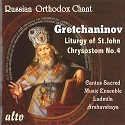
10. Alexander Gretchaninov – Liturgy of St John Chrysostom No. 4: We have seen the True Light – A protégé of Rimsky-Korsakov, Alexander Gretchaninov was one of the earliest composers to flee Communist restrictions; not only were they a threat to him artistically, but they were at odds with his deep religious faith. He ultimately spent the final thirty years of his life in France and the United States, watching World War Two and Stalin’s reign from afar.

11. Yury Shaporin – The Decembrists: Soldiers’ Chorus – One result of Stalin’s restrictions on music was that very few operas of any merit were produced. Shaporin’s The Decembrists took over 25 years to come to fruition, in part because of constant demands by the authorities for revision, and it wasn’t premiered until a few months after Stalin’s death. Despite the rampant censorship, it was good enough to gain the support of Shostakovich, who was usually no champion of Shaporin’s music.

12. Tikhon Khrennikov – Much Ado…Because of Hearts: Kanzone des Bretunkenen – One of the prominent villains in Soviet music was Tikhon Khrennikov, who as Secretary of the Union of Soviet Composers worked tirelessly to promote Zhdanov’s ideals and stamp out modernism and “anti-proletarian” music. Naturally, his music was regularly presented as a reference for Soviet realism, and it has largely vanished since the collapse of the USSR.

13. Lev Knipper – Meadowland (Polyushko Polye) – A prolific composer who managed to avoid censorship, Knipper also served as a secret agent for the USSR during World War Two. The Kremlin recruited musicians, ballerinas, and acrobats to assassinate Nazi leaders should Moscow fall and the Germans attempt to organize celebratory concerts. Knipper was charged with killing Hitler himself should the opportunity arise.


14. Dmitry Kabalevsky – Symphony No. 1: II. Allegro molto agitato e con spirito – Kabalevsky was another composer whose association with the Zhdanov Doctrine was probably more political than artistic. Despite having very conservative and populist musical tendencies, he was slated for denunciation before his official connections succeeded in getting his name removed from the list.


15. Vladimir Jurowski – Symphonic Pictures, “Russian Painters”: IV. Morning of the Streltsy’s Execution – After Stalin died, Nikita Khrushchev took over the USSR, and he brought in a brief period known as Khrushchev’s Thaw. Restrictions on art were (slightly) loosened, and in 1956 there was held an exhibition in St Petersburg of paintings previously kept unseen. Jurowski used seven of these works as inspiration for his Symphonic Pictures.

16. Galina Ustvolskaya – Bol’shoy Duet, “Grand Duet”: II. – — Ustvolskaya’s laser-like work was too unusual to gain much performance in the USSR, but it was also too unusual to fit neatly into what the censors liked to prohibit. Shostakovich, her teacher, said, “I am convinced that the music of G.I. Ustvolskaya will achieve worldwide renown, to be valued by all who perceive truth in music to be of paramount importance.”


17. Alexander Mosolov – Zavod (Iron Foundry) – Alexander Mosolov was drawn to futurism early in his career, and he enjoyed considerable dissonance and chromaticism. This didn’t sit well with the Soviet authorities, of course, and in 1937 he was imprisoned for alleged counter-revolutionary activities. Originally sentenced to eight years, he was released after eight months thank to intervention by Glière and Myaskovsky, though he remained in exile for five years.

18. Gavriil Popov – Symphony No. 1: III. Presto – Popov displayed every bit as much potential as Shostakovich in his Symphony No. 1, but immediately after its premier, the work was banned and never performed again in his lifetime. Fearing further reprisal from the authorities, his composition style changed to conform to the government’s expectations, and his work never lived up to the potential displayed in this symphony.


19. Alfred Schnittke – Concerto Grosso I: II. Toccata – Like many Soviet composers, Schnittke paid the bills by composing nearly seventy film scores, an outlet that allowed slightly greater stylistic freedom as long as it served the story. For his more “serious” compositions he often utilized a technique of his own, polystylism, which combined elements of many different styles and eras of composition into one big collage of sound.


20. Nikolay Roslavets – Prelude No. 5 – Roslavets was a futurist composer who ran afoul of cultural purges in the 1920s. Accused of being anti-proletariat and formalist, he was ultimately banned from holding any official position. His music was actively suppressed throughout the Soviet Era, and his name was even expunged from musical dictionaries for thirty years after his death, finally returning in 1978 in a negative context.


Each month, Naxos Music Library presents a themed playlist for our subscribers to enjoy. We know that a database of over 1.85 million tracks can be a bit daunting, so we'd like to highlight some of the amazing music that is available to you. Let it kickstart discovery!