As a woman and as a musician I stand fully behind Women's History Month. First, women fought to be taught music. Once music was considered a worthwhile pursuit for well-off ladies (in the parlour only, of course), they had to fight to perform, fight for the stage in the opera and the concert hall. And you would hope or maybe even expect that women would be much more welcomed as composers in this day and age. While there are many more being performed (especially in the new music/alt-classical/contemporary classical movement), the reality remains that female composers still fight for exposure, performance, and Aretha's most coveted commodity: R-E-S-P-E-C-T. Furthermore, it's amazing how many people, classical music devotees included, can't name a female composer other than perhaps Joan Tower.
So here are a few of my favorite living composers who happen to be women (and their works). Movers, shakers, wave-makers, iconoclasts, creators. Listen up.
(I'm getting a little minimalist on you here--just names and music. I don't want to color your expectations too much. I hope all with rococo tendencies can forgive me.)
Sofia Gubaidulina - Bassoon Concerto - CHAN9717
Emma Lou Diemer - Piano Quartet - LAN0328
Joan Tower - Wild Purple - 8.559215
Ellen Taaffe Zwilich - Fantasy for Harpsichord - TROY457
Tania Leon - Bailarin - BCD9239
Hilary Tann - Gardens of Anna Maria Lusia de'Medici - PH05019
Libby Larsen - Black Birds, Red Hills - INNOVA512
Julia Wolfe - Cruel Sister - CA-21069
Jennifer Higdon - On a Wire - ASO1001
Gabriela Ortiz - Altar de Neon - DOR-90245
Liza Lim - Weaver-of-Fictions - ABC4766439
Gabriela Lena Frank - HILOS - 8.559645
Lera Auerbach - Ballet for a Lonely Violinist - BIS-CD-1592
Augusta Read Thomas - Silhouettes - TROY855
Pro musica,
Mo
nmlhelp@naxosusa.com

Monday, March 14, 2011


Where My Girls At? Pt. I
We all know that the big winner for March is Women's History Month*. Some folks get in a twist about Women's History Month (as though the advances of the last 90 years mean that women no longer need our own history month) to which I say "Pshaw!"
Most people know about those big-name musical foremothers like Hildegaard von Bingen, Fanny Mendelssohn-Hensel, and Clara Wieck-Schumann, but what about the others? Here's your freshman Intro to Music History, Lady-Style.
 Elisabeth-Claude Jacquet de la Guerre
Like many women in music, Elisabeth Jacquet de la Guerre was hailed as a virtuosic performer before she came to light as a composer. While she composed in most of the forms of the day, her most well known works remain those she wrote for her own instrument--the keyboard.
Found it on the NML: Harpsichord Suites Nos. 1-4, HCD31729
Barbara Strozzi
Barbara Strozzi was a noted Venetian woman, the adopted daughter of playwright Giulio Strozzi. The surviving body of her work is vocal in nature, both solo and ensemble, ranging from madrigals to arias. The heavily vocal nature and similar pitching corroborates the view that much of her work was written for her own performance in her home.
Found it on the NML: Il primo libro de madrigali, Op. 1, CTH2441-2
 Alma Mahler-Werfel
Wife of Gustav Mahler. Alma Mahler was another woman composer whose work was largely suppressed by male influence--though not in such a benign way. Gustav Mahler thought it "unseemly" not only for women to compose, but for both members of a couple to compose. It is believed that he actively forbade her to compose, under the auspice of removing any barriers to her wifely duties. She resumed composition after Mahler's death.
Found it on the NML: 5 Lieder, 999018-2
Liza Lehmann
The English soprano Liza Lehmann actually composed little before her marriage and the end of her performing career. She had a respectable career as a singer, but when struck by Bell's palsy she lost fine control of her vocal folds. At that time she turned back to composition, for which she had shown an aptitude when young but never pursued seriously. She enjoyed a fair amount of popularity in her lifetime with song cycles such as Daisy Chain, Cherry Ripe, and In a Persian Garden, and often accompanied her own compositions at the piano.
Found it on the NML: Daisy Chain, 8.557118
 Amy Beach
Amy Beach is particularly notable as the first American woman to experience large-scale success as a composer. As a young girl, Amy Cheney was, like many other females, to begin her career as a well-known performer. Once she married, becoming Mrs. H.H.A. Beach, her husband decided that she would compose rather than perform. She composed 300 works in her lifetime, nearly all of which were commercially published. This widespread success made her a giant among women in music.
Found it on the NML: String Quartet, Op. 89, CHAN10162
Johanna Beyer
Johanna Beyer worked in relative obscurity in her lifetime, largely ignored as a composer even by the experimental music community. She continued to study with teachers like Henry Cowell and Ruth Crawford Seeger, whose influence can be heard in her harmonic and contrapuntal language. The work has been explored further posthumously and Beyer is beginning to gain posthumous respect as an experimental composer.
Found it on the NML: Clarinet Suite No. 2 in Bb major, INNOVA589
 Nadia Boulanger
The elder Boulanger sister composed much less prolifically than did the younger. It is believed that Nadia thought Lili to be much more gifted than she herself was, which likely led to her halt in composition. Nadia proceeded to have an extremely active international career as an organist, composer, conductor, and educator. She championed the music of her pupils at every turn, among whom were counted Bernstein, Virgil Thomson, Carter, and Copland.
Found it on the NML: Pieces for Cello and Piano, 8.223636
Lili Boulanger
Lili Boulanger was the possessor of another nascent performing career cut short by illness. She relied solely on private instruction for her musical education, as her frailty precluded a full conservatory education. Remarkably, she became the first woman to ever win the Prix de Rome with her work Faust et Helene in 1913. The broad use of orchestral color in her compositions was considered quite imaginative, as was her later exploration of polytonalality.
Found it on the NML: Faust et Helene, CHAN9745
Pro (women's) musica,
Mo
nmlhelp@naxosusa.com
*Other March things that I deem "pretty awesome" include International Women's Day, International Book Day, National Grammar Day, and March Madness. I'm just saying.
Most people know about those big-name musical foremothers like Hildegaard von Bingen, Fanny Mendelssohn-Hensel, and Clara Wieck-Schumann, but what about the others? Here's your freshman Intro to Music History, Lady-Style.
 Elisabeth-Claude Jacquet de la Guerre
Like many women in music, Elisabeth Jacquet de la Guerre was hailed as a virtuosic performer before she came to light as a composer. While she composed in most of the forms of the day, her most well known works remain those she wrote for her own instrument--the keyboard.
Found it on the NML: Harpsichord Suites Nos. 1-4, HCD31729
Barbara Strozzi
Barbara Strozzi was a noted Venetian woman, the adopted daughter of playwright Giulio Strozzi. The surviving body of her work is vocal in nature, both solo and ensemble, ranging from madrigals to arias. The heavily vocal nature and similar pitching corroborates the view that much of her work was written for her own performance in her home.
Found it on the NML: Il primo libro de madrigali, Op. 1, CTH2441-2
 Alma Mahler-Werfel
Wife of Gustav Mahler. Alma Mahler was another woman composer whose work was largely suppressed by male influence--though not in such a benign way. Gustav Mahler thought it "unseemly" not only for women to compose, but for both members of a couple to compose. It is believed that he actively forbade her to compose, under the auspice of removing any barriers to her wifely duties. She resumed composition after Mahler's death.
Found it on the NML: 5 Lieder, 999018-2
Liza Lehmann
The English soprano Liza Lehmann actually composed little before her marriage and the end of her performing career. She had a respectable career as a singer, but when struck by Bell's palsy she lost fine control of her vocal folds. At that time she turned back to composition, for which she had shown an aptitude when young but never pursued seriously. She enjoyed a fair amount of popularity in her lifetime with song cycles such as Daisy Chain, Cherry Ripe, and In a Persian Garden, and often accompanied her own compositions at the piano.
Found it on the NML: Daisy Chain, 8.557118
 Amy Beach
Amy Beach is particularly notable as the first American woman to experience large-scale success as a composer. As a young girl, Amy Cheney was, like many other females, to begin her career as a well-known performer. Once she married, becoming Mrs. H.H.A. Beach, her husband decided that she would compose rather than perform. She composed 300 works in her lifetime, nearly all of which were commercially published. This widespread success made her a giant among women in music.
Found it on the NML: String Quartet, Op. 89, CHAN10162
Johanna Beyer
Johanna Beyer worked in relative obscurity in her lifetime, largely ignored as a composer even by the experimental music community. She continued to study with teachers like Henry Cowell and Ruth Crawford Seeger, whose influence can be heard in her harmonic and contrapuntal language. The work has been explored further posthumously and Beyer is beginning to gain posthumous respect as an experimental composer.
Found it on the NML: Clarinet Suite No. 2 in Bb major, INNOVA589
 Nadia Boulanger
The elder Boulanger sister composed much less prolifically than did the younger. It is believed that Nadia thought Lili to be much more gifted than she herself was, which likely led to her halt in composition. Nadia proceeded to have an extremely active international career as an organist, composer, conductor, and educator. She championed the music of her pupils at every turn, among whom were counted Bernstein, Virgil Thomson, Carter, and Copland.
Found it on the NML: Pieces for Cello and Piano, 8.223636
Lili Boulanger
Lili Boulanger was the possessor of another nascent performing career cut short by illness. She relied solely on private instruction for her musical education, as her frailty precluded a full conservatory education. Remarkably, she became the first woman to ever win the Prix de Rome with her work Faust et Helene in 1913. The broad use of orchestral color in her compositions was considered quite imaginative, as was her later exploration of polytonalality.
Found it on the NML: Faust et Helene, CHAN9745
Pro (women's) musica,
Mo
nmlhelp@naxosusa.com
*Other March things that I deem "pretty awesome" include International Women's Day, International Book Day, National Grammar Day, and March Madness. I'm just saying.
Wednesday, March 9, 2011
Enhanced Search - Find What You're Looking For!
The curtain opens on a college music library. It's a warm environment, and the sound of music fills the background, just audible enough to know that it's there. An Amazing Librarian is working behind the circulation desk, where a student approaches...
(Nick)
Hi - My name is Nick!
I'm putting on my recital and I've come to the College Music Library for some help. I've got a lot of "loud- bangy-things" on the program already, and think something on the Marimba would be great. Can you help me find what I'm looking for?
(Amazing Librarian)
Hello Nick! Let's use the Naxos Music Library to find something! Simply go to the Enhanced Search, and enter "Marimba" in the instrument field. That should get you started.
(Nick)
Wow...Great! However, I've heard of this composer.. Ney Rosauro - who composed a whole bunch of Brazilian music, which would round out the program nicely. Can these results be refined down?
 (Amazing Librarian)
Yes they can! By adding the composers name to the Composer box - your search is refined! Look at that, here are 6 discs that contain music by Ney.
(Nick)
Great - but I've only got about 5 minutes left in the recital to add a new piece- would you mind narrowing it down for me?
(Amazing Librarian)
Not a problem! Simply enter the duration in the box, and include it into your results...and...Voila! We've got these 4 discs that contain Ney Rosauro marimba works between 5 and 6 minutes long! Happy Listening!
Include AND Exclude Terms!
Alright - while the above may be a bit "over the top" - it's an incredibly real scenario. With the new Naxos Enhanced Search - coming to the Naxos Music Library, Naxos Jazz Library, and Naxos Spoken Word Library soon - you'll be able to use these resources to aid members!
Not only will you be able to include and filter results in real-time, but you'll be able to "exclude" certain things from your searches as well!
Let's say that I'm looking for a disc to listen to that's got the following:
- A piece composed by Bach
- On the Naxos Label
- It contains the Viola
- It does not contain any Cello
*The NML has 2 discs that meet this criteria!
The new Enhanced Search will allow you to do this, with near instant results that can be constantly filtered "down" or "up" depending on your level of specificity. Here's the evolution of the above search.
First - All discs that contain pieces composed by Bach.
Secon d - Narrow that list down, by including only those Bach compositions on the Naxos label.
 Third - Let's get this list more manageable - filter out anything that contains the Cello. This will return all of the discs that contain Bach, on the Naxos Label, with no cello.
Finally - We only want discs that contain the Viola, from that list. We get our 2 discs!

Results Filtered By Country
And the last, but certainly not the least, feature to mention here, is that country restricted recordings will no longer be shown in your search results. For our friends in the United States trying to do a search for Elvis (wanting Costello, but getting Presley) - the wait is over. For our friends in Hong Kong, Korea, Canada, and beyond - we're all getting customized results!
Here's an example of what 2 different subscribers will see - one is a student in the United States. The other, is a musician in Canada.
Canada - (No Restrictions on Recordings) - USA (Many Restricted Recordings)


All in all - we hope you enjoyed this short look at some of the interesting Enhanced Searches we were able to perform. We look forward to the days ahead where we can all search together!
We appreciate any and all feedback on the design plans - so please post below or email us directly with your comments! Who knows...you may be the one to add a feature that millions will use every day!
Happy Searching,
Nick
Nick D'Angiolillo
Naxos of America, Inc.
615.465.3836 (direct)
Nick@NaxosUSA.com


(Nick)
Hi - My name is Nick!
I'm putting on my recital and I've come to the College Music Library for some help. I've got a lot of "loud- bangy-things" on the program already, and think something on the Marimba would be great. Can you help me find what I'm looking for?
(Amazing Librarian)

Hello Nick! Let's use the Naxos Music Library to find something! Simply go to the Enhanced Search, and enter "Marimba" in the instrument field. That should get you started.
(Nick)
Wow...Great! However, I've heard of this composer.. Ney Rosauro - who composed a whole bunch of Brazilian music, which would round out the program nicely. Can these results be refined down?
 (Amazing Librarian)
Yes they can! By adding the composers name to the Composer box - your search is refined! Look at that, here are 6 discs that contain music by Ney.
(Nick)
Great - but I've only got about 5 minutes left in the recital to add a new piece- would you mind narrowing it down for me?
(Amazing Librarian)

Not a problem! Simply enter the duration in the box, and include it into your results...and...Voila! We've got these 4 discs that contain Ney Rosauro marimba works between 5 and 6 minutes long! Happy Listening!
Include AND Exclude Terms!
Alright - while the above may be a bit "over the top" - it's an incredibly real scenario. With the new Naxos Enhanced Search - coming to the Naxos Music Library, Naxos Jazz Library, and Naxos Spoken Word Library soon - you'll be able to use these resources to aid members!
Not only will you be able to include and filter results in real-time, but you'll be able to "exclude" certain things from your searches as well!
Let's say that I'm looking for a disc to listen to that's got the following:
- A piece composed by Bach
- On the Naxos Label
- It contains the Viola
- It does not contain any Cello
*The NML has 2 discs that meet this criteria!
The new Enhanced Search will allow you to do this, with near instant results that can be constantly filtered "down" or "up" depending on your level of specificity. Here's the evolution of the above search.
First - All discs that contain pieces composed by Bach.

Secon
 d - Narrow that list down, by including only those Bach compositions on the Naxos label.
 Third - Let's get this list more manageable - filter out anything that contains the Cello. This will return all of the discs that contain Bach, on the Naxos Label, with no cello.
Finally - We only want discs that contain the Viola, from that list. We get our 2 discs!

Results Filtered By Country
And the last, but certainly not the least, feature to mention here, is that country restricted recordings will no longer be shown in your search results. For our friends in the United States trying to do a search for Elvis (wanting Costello, but getting Presley) - the wait is over. For our friends in Hong Kong, Korea, Canada, and beyond - we're all getting customized results!
Here's an example of what 2 different subscribers will see - one is a student in the United States. The other, is a musician in Canada.
Canada - (No Restrictions on Recordings) - USA (Many Restricted Recordings)


All in all - we hope you enjoyed this short look at some of the interesting Enhanced Searches we were able to perform. We look forward to the days ahead where we can all search together!
We appreciate any and all feedback on the design plans - so please post below or email us directly with your comments! Who knows...you may be the one to add a feature that millions will use every day!
Happy Searching,
Nick
Nick D'Angiolillo
Naxos of America, Inc.
615.465.3836 (direct)
Nick@NaxosUSA.com
Join in the conversation!
Wednesday, February 23, 2011
You Can't Handel The Truth
Today is the 326th birthday of the incomparable, the illustrious, the inspired George Frideric Handel! The kicking king of Kappellmeisters! The hot harpsichordist of Halle! Old-school originator of the oratorio! So our purpose here is clear: sit back and marvel at the man, the master, the myth.
If you think you can Handel it. *

GRAND.
Handel, George Frideric (2/23/1685-4/14/1759)
Born in the German town of Halle in 1685, Handel studied briefly at the University of Halle, before moving to Hamburg in 1703, where he served as a violinist in the opera orchestra and subsequently as harpsichordist and composer. From 1706 until 1710 he was in Italy, where he further developed his mastery of Italian musical style. Appointed Kapellmeister to the Elector of Hanover, the future George I of England, he visited London, where he composed the first London Italian opera Rinaldo, in 1710 and settled there two years later. He enjoyed aristocratic and later royal patronage, and was occupied largely with the composition of Italian opera with varying financial success until the 1740s. He was successful in developing a new form, English oratorio, which combined the musical felicities of the Italian operatic style with an increased rôle for the chorus, relative economy of production and the satisfaction of an English and religious text, elements that appealed to English Protestant sensibilities. In London he won the greatest esteem and exercised an influence that tended to overshadow the achievements of his contemporaries and immediate successors. He died in London in 1759 and was buried in Westminster Abbey in the presence of some 3000 mourners. Operas Handel wrote over forty Italian operas, the majority for staging in London. The operatic conventions of the time, restricting subject and form, and the major use of castrato singers in the principal male rôles, led to a general neglect of this important part of Handel's work until recent years, with the increased cultivation of male soprano and male alto voices and a growing understanding of Handel's achievement within the limitations of the genre. Arias and other operatic excerpts, however, have retained a continued place in vocal and to some extent in instrumental repertoire. In particular the aria from the opera Serse of 1738, Ombra mai fù, popularly known as Handel's Largo, has re-appeared in every possible arrangement. Other arias are familiar in something approaching their original form. These include Lascia ch'io pianga from Rinaldo, Piangèro la sorte mia from Giulio Cesare and Care selve from Atalanta. Oratorios Messiah is by far the best known of all English oratorios. Its three parts deal with the birth, passion and resurrection of Christ, using a text in part derived from the Bible and from the version of the Psalms familiar from the Church of England Book of Common Prayer. The work was completed and first performed in 1742 and later repeated annually in London in aid of the Foundling Hospital. Israel in Egypt, Judas Maccabaeus, Samson, based on Milton, and Solomon are only some of the English oratorios of Handel that are familiar in whole or in part to choirs and audiences. To these may be added the secular oratorio Semele, with a text by the dramatist William Congreve, dealing with an episode from classical mythology and including, for a disguised Jupiter, the well known aria Where'er you walk. Church Music Handel wrote music for the Catholic liturgy in 1707, when he was in Rome. In England, under the patronage of the Duke of Chandos, he wrote a set of anthems, the so-called Chandos Anthems. The four Coronation Anthems, written for the coronation of George II in 1727, represent music for a royal ceremonial occasion at its most impressive. Other settings for the Anglican liturgy include the Utrecht Te Deum of 1713, celebrating the Peace of Utrecht, and the Dettingen Te Deum, a celebration of the victory of Dettingen over the French army in 1743. Secular Vocal & Choral Music The story of the shepherd and shepherdess Acis and Galatea and the monster Polyphemus forms the basis of the pastoral Acis and Galatea, first performed in 1718. The aria of Polyphemus O ruddier than the cherry is in popular baritone repertoire. L'allegro, il penseroso ed il moderato, based on Milton and completed in 1740, provides at least one popular soprano aria, Sweet bird. In the earlier part of his career Handel wrote a large number of solo and duo Italian cantatas, with instrumental accompaniment, as well as vocal duets and trios with the more economical accompaniment of basso continuo, a chordal and a bass instrument. This last repertoire deserves further exploration. Orchestral Music Since Corelli, a musician who was said to have found Handel's "French" style alien to Italian tradition, the concerto grosso had continued as the most popular Baroque orchestral form, with a small concertino group, usually of two violins, cello and harpsichord, contrasted with the whole string orchestra. Handel wrote and published in 1739 a set of twelve such concertos, Opus 6, designed originally for strings and continuo. An earlier compilation of six concerti grossi, scored also for wind instruments, had been published in London in 1734. Alexander's Feast is the name given to one of the concertos first performed with the choral work of that name, a setting of Dryden in celebration of the Feast of St. Cecilia, patron saint of music, in 1736. His sixteen Organ Concertos, the first six included in Opus 4 and a further six in Opus 7, served a practical and novel purpose as interval music, to be played at performances of oratorio. No. 13 is generally known as The Cuckoo and the Nightingale. The Water Music is a set of pieces written in 1717 to entertain George I as he was rowed up the Thames to supper at Chelsea, and the Music for the Royal Fireworks, written in 1749, preceded a firework display in Green Park, a celebration of the Peace of Aix-la-chapelle. Chamber Music Music for smaller groups of performers by Handel includes a number of Trio Sonatas, the majority for two violins and basso continuo, and a number of sonatas for solo instrument and continuo, six for recorder and six for violin. The publisher of the twelve sonatas of Opus 1, about 1730, described a dozen of these sonatas as for treble instrument and continuo, allowing potential performers a freedom of choice that was not altogether unusual at the time. Keyboard Music Handel was as versatile as any musician of his age. He excelled, however, as a keyboard-player, judged in an early contest in Rome with the harpsichordist Domenico Scarlatti, with the wisdom of Solomon, as the better organist, while Scarlatti was honoured as the better harpsichordist. Handel left a great deal of keyboard music, most of it for the harpsichord and much of it written early in his career. The first eight Suites for harpsichord were published by the composer in 1720, followed in 1733 by a second collection of eight Suites, assembled largely by the publisher. The G major Chaconne, using a popular Baroque variation form, consists of 62 variations on a simple repeated bass pattern. The Air from Suite No. 5, with its five following variations, has won fame under the title The Harmonious Blacksmith, a reference to an unlikely anecdote concerning the inspiration of the piece.
Pro (Handelian) musica,
Mo
nmlhelp@naxosusa.com
*I apologize for overusing this kitsch. I use it every year and it never gets old for me.
Friday, February 4, 2011
Celebrate Black History Month !
 If you aren't on our NML monthly update, you're missing out on great monthly offers (for some Free Stuff!)
Sign up for the Email Newsletter Here!
February is Black History Month--a time dedicated to honoring Black Americans and their contributions throughout history.
From a musical standpoint, Jazz is one of the greatest gifts that Black American musicians have given the world. In all its forms from big band to solo improv, from traditional to experimental, from formal to funky, Jazz has altered the musical landscape beyond recognition.
In honor of Black History Month Naxos is offering a three-month free trial of Naxos Music Library Jazz for your students. That's an extra two months of free streaming jazz from labels like Fantasy Records, Naxos Jazz, Jazzwerkstatt, and Innova! E-mail us now to start your trial.
Featured Jazz Labels
NML Jazz offers thousands of recordings from over 50 labels. In addition to enjoying the NMLJazz on your computer, it's got a fully functioning iPhone App! Check the App store to download and enjoy Jazz greats on the go!We proudly feature the Fantasy Jazz collection--a monumental jazz catalog with over 23,000 tracks from nearly 500 renowned artists.

In addition the classics on Fantasy, you can find traditional, contemporary, experimental, and more on other labels like these.


Have a Jazzy Weekend!
Nick
Nick D'Angiolillo
615.465.3836
MusicLibrary@NaxosUSA.com
Join in the conversation!
Thursday, January 27, 2011
I. Love. Free Stuff. - Orchestras and the NML
I’m such a sucker for free things. I’m guilty of buying that extra can of soup at the store, because – hey it’s “buy one - get one free". It’s only natural then, that the idea of getting (and giving) free NML excites me.
We’ve got some fantastic orchestra partners who utilize the NML as part of the promotional and research tools, and we wanted to talk a bit about how they’re using the NML! Imagine buying a concert package and getting to use the entire NML for free. Yes. Please.
This isn't an exhaustive list though, so check with your local Orchestra or Performing Arts organization and see if they have any fun NML programs too!
Toronto Symphony Orchestra
Kansas City Symphony
We’ve got some fantastic orchestra partners who utilize the NML as part of the promotional and research tools, and we wanted to talk a bit about how they’re using the NML! Imagine buying a concert package and getting to use the entire NML for free. Yes. Please.
This isn't an exhaustive list though, so check with your local Orchestra or Performing Arts organization and see if they have any fun NML programs too!
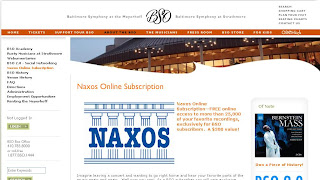
The BSO pulls out all the stops with a full-blown Naxos page. BSO subscribers can connect to the NML before they leave the house. You know – to listen to a bit of Mahler as you get ready, before going to enjoy some live Mahler, with a side of Mahler through the NML Android App on the way home. Mahler overload, Yes. Possible, Absolutely!
Toronto Symphony Orchestra
 The TSO wants to make sure that everyone in the Toronto area has access to great music. They’ve created the “Beethoven on Demand” program, and offer the NML to their members. What a great program name, no?

Our very own Nashville Symphony Orchestra musicians and season ticket subscribers get to enjoy the NML. Hey, who knows, maybe the Nashville musicians listen to themselves on the awesome (Grammy Nominated!) “Metropolis” disc. (8.559635)
Also, let's be honest - I really just wanted an excuse to post this awesome cover art (and talk about a super-hero themed recording).
If you find yourself in Detroit Rock City, enjoy the NML and some “rock favorites” by legends Johnny Cash, Jerry Lee Lewis, and Roy Orbison! Yes, these are all included in the DSO “subscriber subscription” to the NML (and yours too!).
Kansas City Symphony
The KC Symphon y’s done a great job of providing donors and subscribers with a fantastic value-add. If you’re a donor to the Orchestra, one of the many perks (aside from Priority seating and ticket exchange) is an upgraded sound quality NML subscription!
Vancouver Symphony Orchestra
The VSO musicians write us all the time talking about how much they enjoy using the NML. It’s great to be able to assist in the research and concert prep!
Winnipeg Symphony Orchestra
These “Manitobans” enjoy the NML , even when it’s too cold to go outside. Ok, maybe it’s never too cold for them, but when I see temperatures of -21 degrees Celsius, I start to shiver.

If I was an Edmonton Symphony Orchestra musician, I know I’d spend my “research and listening” hours near the giant wave-pool at the awesome indoor World Waterpark.

Until more "Free Things",
Nick
Nick D'Angiolillo
MusicLibrary@NaxosUSA.com
615.465.3836
Join in the conversation!
Subscribe to:
Posts (Atom)