Tuesday, January 4, 2011

Alt-Classical

With all the buzz out there regarding small-label alt-classical, I thought I should let you know just how much you can find on the NML. Here's a quick sampling of labels and albums to hear in this genre.


New Amsterdam
New Amsterdam Records was formed as a haven for the young New York composers and performers whose music slips through the cracks between genres. Artists include the ‘adventurous cello songstress’ Jody Redhage and the band Build (made up of violin, cello, piano, bass and drums, and led by composer/violinist Matt McBane).

Sarah Kirkland Snider- Penelope NWAM023
Missy Mazzoli/Victoire- Cathedral City NWAM025
Janus- i am not NWAM024
Corey Dargel- Someone Will Take Care of Me- NWAM021


Cantaloupe Music
Cantaloupe Music is the record label created in March 2001 by the three founders of New York's legendary Bang on a Can Festival: composers Michael Gordon, David Lang, and Julia Wolfe, and Bang on a Can managing director Kenny Savelson. Cantaloupe Music has made a massive impact in the new music community, and been recognized by critics and fans around the globe for its adventurous sounds. Their goal is to provide a home for "music that slips between the cracks."

David Lang - Child CA-21013
Tristan Perich - 1-Bit Symphony CA-21054
So Percussion/Matmos - Treasure State CA-21065
Evan Ziporyn - Melody Competition CA-21022


Innova
Innova recordings (founded in 1982) is the record label of the American Composers Forum. Innova champions work that pushes and challenges the boundaries of contemporary music. From Avant-jazz to Electronic music, to the very latest from the Classical frontlines, innova chronicles music before it hits mainstream ears.

Harry Partch - 11 Intrusions INNOVA561
Judith Shatin - Tower of the Eight Winds INNOVA770
Maya Beiser - Provenance INNOVA778


Non Classical
Established by Gabriel Prokofiev, the grandson of Sergei (yes, THAT Sergei Prokofiev), the label Nonclassical represents Gabriel’s determination to re-engage pop fans with classical music by breaking down the barriers of genre. Each CD of forward-thinking compositions comes with a selection of remixes from electronic producers.

John Matthias and Nick Ryan - Cortical Songs NONCLSS004
Mercury Quartet - Mercury Acoustic NONCLSS009
Gabriel Prokofiev - String Quartet No. 1 with Remixes NONCLSS001


Open up to the alt-classical movement. It might change the way you think about classical music. Just ask Judd Greenstein.


Pro musica,

Mo
nmlhelp@naxosusa.com

Monday, December 27, 2010

UPDATE: NML App for Android Now Live!


The brand spankin' new NML App for Android is now live! Find it on the Android Market by searching "Naxos Music Library" (or just "Naxos" if you're into brevity) or hit this QR code with your Droid.


You will be able to listen to personal, institutional, and Naxos-created playlists as well as browse and stream the full NML on the go from your Droid!


Institutional Users

1. Visit the NML. If you are a member of an institution like a school, university, or public library, you can visit your institution’s unique webpage (ex. http://myschool.naxosmusiclibrary.com). Ask your librarian or contact us here at Naxos if you’re not sure how to get there.

2. Navigate to the Playlists tab and sign up for a Student/Member Playlist Account. You will receive a confirmation e-mail to the e-mail address you used to sign up. Click the link in the e-mail to confirm your account.


3. The login you created for your Student/Member Playlist Account will be your login for the app as well.

4. Any playlist in your personal folder or your institution’s folder will be available, in addition to all of our Naxos-created playlists. You can also browse and stream the full NML--from New Releases and Recent Additions to any old recording from any label--anytime, anywhere.


Individual Users

You will not need to adjust anything to use the app. Just use your normal NML login to log in to the app.


As always, if you have any questions or need help with the app, please call or e-mail me!


Pro (mobile) musica,


Mo

nmlhelp[at]naxosusa[dot]com

Monday, December 20, 2010

NML App for Android Goes Live 12.27.10

We've heard that some people (clearly silly ones) think that classical music is behind the times.
We, keepers of the NML, disagree.
We think you should be able to listen to a Barbara Strozzi aria or a Mahler symphony just as easily as a Janelle Monae album. So we continue to work on making our music as mobile as possible.

You probably already know about our apps for iPhone, iPad, and iPod Touch--but Apple Resisters can now prepare to rejoice, because...


The Naxos Music Library App for Android will go live on December 27, 2010!

You will be able to listen to personal, institutional, and Naxos-created playlists as well as browse and stream the full NML on the go from your Droid!


Just search the Android Market for "Naxos Music Library" to download the free app!


Once the app is installed, it's time to make sure you have some playlists!


Institutional Users

1. Visit the NML. If you are a member of an institution like a school, university, or public library, you can visit your institution’s unique webpage (ex. http://myschool.naxosmusiclibrary.com). Ask your librarian or contact us here at Naxos if you’re not sure how to get there.

2. Navigate to the Playlists tab and sign up for a Student/Member Playlist Account. You will receive a confirmation e-mail to the e-mail address you used to sign up. Click the link in the e-mail to confirm your account.


3. The login you created for your Student/Member Playlist Account will be your login for the app as well.

4. Any playlist in your personal folder or your institution’s folder will be available, in addition to all of our Naxos-created playlists. You can also browse and stream the full NML--from New Releases and Recent Additions to any old recording from any label--anytime, anywhere.


Individual Users.

You will not need to adjust anything to use the app. Just use your normal NML login to log in to the app!


We'd like to also take a moment to give a big thank you to our developers. The app works and looks great--all that hard work has paid off. So THANK YOU!


As always, if you have any questions or need help with the app, please call or e-mail me!


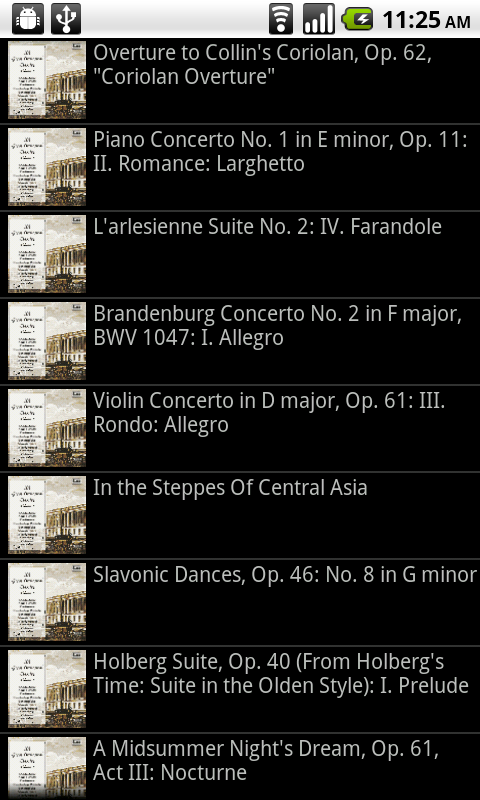
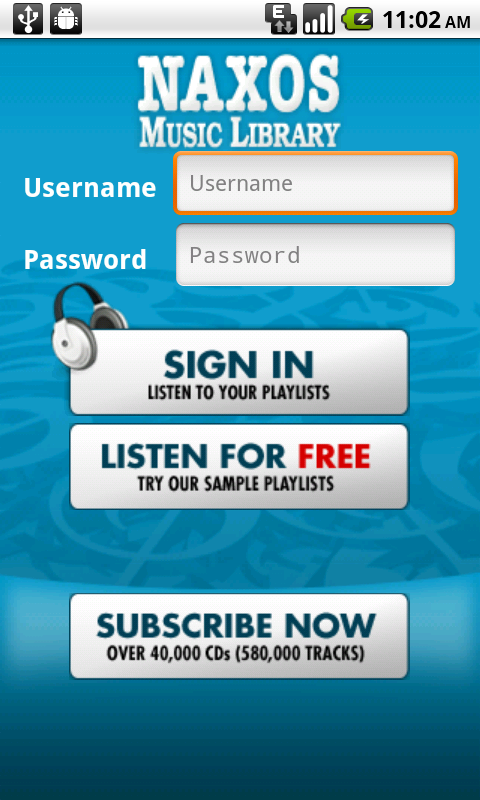
In the meantime, check out these action shots.


Pro (mobile) musica,


Mo

nmlhelp[at]naxosusa[dot]com


Wednesday, December 15, 2010

Respect the Classics

Sometimes I think the big names in classical music get a bum rap just for being well known. Maybe it's a form of classical music hipsterism. So on this, his 240th birthday, it's time to show some respect to The Most Classic of Classical Composers. He's the one everyone knows, and for good reason. It's 1770. Enter Ludwig van Beethoven.

Born in Bonn in 1770, the eldest son of a singer in the Kapelle of the Archbishop-Elector of Cologne and grandson of the Archbishop's Kapellmeister, Beethoven moved in 1792 to Vienna, where he had some lessons from Haydn and others, quickly establishing himself as a remarkable keyboard-player and original composer. By 1815 increasing deafness made public performance impossible and accentuated existing eccentricities of character, patiently tolerated by a series of rich patrons and his royal pupil the Archduke Rudolph. Beethoven did much to enlarge the possibilities of music and widen the horizons of later generations of composers. To his contemporaries he was sometimes a controversial figure, making heavy demands on listeners both by the length and by the complexity of his writing, as he explored new fields of music.

Stage Works

Beethoven wrote only one opera, eventually called Fidelio after the name assumed by the heroine Leonora, who disguises herself as a boy and takes employment at the prison in which her husband has been unjustly incarcerated. This escape opera, for which there was precedent in contemporary France, ends with the defeat of the evil prison governor and the rescue of Florestan, testimony to the love and constancy of his wife Leonora. Beethoven contemplated other operas, but eventually only wrote the one, first staged in 1805 and mounted again in a revised performance in 1814, under more favourable circumstances. The ballet The Creatures of Prometheus was staged in Vienna in 1801, and he wrote incidental music for various other dramatic productions, including Goethe's Egmont, von Kotzebue's curious The Ruins of Athens, and the same writer's King Stephen.

Choral and Vocal Music

Beethoven's most impressive choral work is the Missa Solennis, written for the enthronement of his pupil Archduke Rudolph as Archbishop of Olmutz, but finished too late for that occasion. An earlier work, the oratorio The Mount of Olives, is less well known. In common with other composers, he wrote a number of songs. Of these the best known are probably the settings of Goethe, which did little to impress the venerable poet and writer, who ignored their existence, and the cycle of six songs known as An die ferne Geliebte (To the Distant Beloved). The song Adelaide is challenging but not infrequently heard.

Orchestral Music

Beethoven completed nine symphonies, works that influenced the whole future of music by the expansion of the traditional classical form. The best known are the Third, "Eroica", originally intended to celebrate the initially republican achievements of Napoleon, the Fifth, the Sixth, "Pastoral", and the Ninth, "Choral". The less satisfactory Battle Symphony celebrates the earlier military victories of the Duke of Wellington. For the theatre and various other occasions Beethoven wrote a number of Overtures, including four for his only opera, Fidelio, one under that name and the others under the name of the heroine, Leonora. Other Overtures include Egmont, Coriolan, Prometheus, The Consecration of the House and The Ruins of Athens. Beethoven completed one violin concerto and five piano concertos, as well as a triple concerto for violin, cello and piano, and a curious Choral Fantasia,for solo piano, chorus and orchestra. The piano concertos were for the composer's own use in concert performance. The Fifth, the so-called "Emperor" Concerto, is possibly the most impressive. The single Violin Concerto is part of the standard repertoire, with two Romances, possible slow movements for an unwritten violin concerto.

Chamber Music

Beethoven wrote ten sonatas for violin and piano, of which the "Spring" and the "Kreutzer" are particular favourites with audiences. He extended very considerably the possibilities of the string quartet, even with his first, Opus 18 set of quartets, but it is possibly the named quartets, the group of three dedicated to Prince Razumovsky and known, therefore, as the Razumovsky Quartets, Opus 59, that are best known. The later string quartets offer great challenges to both players and audience, and include the remarkable Grosse Fuge (Great Fugue) a gigantic work, discarded as the final movement of the String Quartet, Opus 130, and published separately. Other chamber music includes a number of Trios for violin, cello and piano, with the "Archduke" Trio pre-eminent and the "Ghost" Trio a close runner-up, for very different reasons. The Cello Sonatas and sets of Variations for cello and piano, including one set based on Handel's See here the conquering hero comes and others on operatic themes from Mozart, are a valuable part of any cellist's repertoire. Chamber music with wind instruments and piano include a Quintet, Op. 16, for piano, oboe, clarinet, horn and bassoon.

Piano Music

Beethoven's 32 numbered piano sonatas make full use of the developing form of piano, with its wider range and possibilities of dynamic contrast. There are also interesting sets of variations, including a set based on God save the King and another on Rule, Britannia, variations on a theme from the Eroica Symphony and a major work based on a theme by the publisher Diabelli. The best known of the sonatas are those that have earned themselves affectionate nicknames, the Pathétique, Op. 13, Moonlight, Op. 27/2, Waldstein, Op. 53, Appassionata, Op. 57, Les Adieux, Op. 81a, and the Hammerklavier, Op. 106. Less substantial piano pieces include three sets of Bagatelles, and the all too well known FŸr Elise, with the Rondo a capriccio, known in English as Rage over a Lost Penny.

Dance Music

Famous composers like Haydn and Mozart were also employed in the practical business of providing dance music for court and social occasions. Beethoven wrote a number of sets of Minuets, German Dances and Contredanses, ending with the so-called Mödlinger Dances, written for performers at a neighbouring inn during a summer holiday outside Vienna.


So celebrate his incredible contributions--from his commanding and revolutionary use of harmony to his single-handed establishment of what would become the romantic symphonic form--by doing some exploratory listening. Personally, I'm going to spend some time with his less-known vocal works.


Pro musica,
Mo
nmlhelp@naxosusa.com

Monday, December 6, 2010

NML iPhone App Tutorial

Here's a step-by-step guide to setting up the Naxos Music Library iPhone App.


If you have questions or concerns, please e-mail me for assistance at nmlhelp@naxosusa.com.


Pro musica,
Mo

Friday, November 19, 2010

Monday, November 8, 2010

App News!

Hey there NMLers!

It is a new week and I have here, flowing through my fingers especially for you, a quick update with some excellent news.
App news, to be specific.


NML iPhone App:
Our app for iPhone, iPad, and iPod has been getting a lot of use since its release last year. We worked out the bugs and upped the pretty factor for version 2.0.
But now we're getting ready for some more updates!
3.0 is currently in testing. The biggest new feature is multitasking so you can keep working/playing/looking at pictures of kittens while your music plays!


NML Droid App
The developers are almost done with the long-promised app for Android! It's also in the final testing stages. If all goes according to plan, we hope to have this app out around December 1!
Get excited, iPhone mutineers!
(No screen shots yet, but we promise to put some up once the date gets closer.)


As always, please call or write if we can answer any questions about the apps-- current standing or coming updates--or the NML. We're always here to help!


Pro musica,
Mo
nmlhelp@naxosusa.com

Thursday, November 4, 2010

Opera in the Present Tense

If you're not an active opera fan you may not know that there's opera other than La Bohème performed in America. No, I don't mean Carmen. Or The Mikado.

I mean opera composed by people who are still alive. This is exciting to me not only due to the excellence of the music, the brilliance of the singers, and the incredible vistas of the sets which are art in themselves. It excites me because there is new life constantly being breathed into the genre.


Here's a sampling of some new American opera that's making waves.

Il Postino--Daniel Catán
Based on the 1994 film by the same name as well as the 1985 novel Ardiente Paciencia by Antonio Skármeta, this opera addresses the end of Chilean poet Pablo Neruda's life in exile from his homeland. Premiered at LA Opera in August 2010.

Shadowboxer--Frank Proto and John Chenault
Based on the tumultuous personal life of boxer Joe Louis. Premiered at the University of Maryland's Clarice Smith Performing Arts Center in April 2010. Along with the pit, the opera calls for an 8-piece jazz combo onstage.

Moby Dick--Jake Heggie
Exactly what it sounds like. This adaptation of the classical Melville novel had a positively triumphant premiere with an all-star cast at the Dallas Opera in April 2010.

The Inspector--John Musto
To be premiered in April 2011 by the Wolf Trap Foundation for the Performing Arts. Loosely based on Gogol's satire The Government Inspector.

Orpheus and Euridice--Ricky Ian Gordon
Orpheus and Euridice saw a smashing success in 2008 at Long Beach Opera. The work casts a soprano as Euridice and a clarinetist as Orpheus, both of whom dance throughout the opera.

Paradise Lost--Eric Whitacre
Whitacre is primarily known for his choral works and caused quite a stir when, at a very high point in his popularity, he announced this work. A mixture of styles was used in what he calls "music theatre." Inspired heavily by Japanese anime and manga, the show melds opera with musical theatre, electronica, film score, and Asian drumming.

Madame White Snake--Zhou Long
A classical Chinese transformation myth about a white snake demon who turns into a beautiful woman in order to experience love. Premiered February 2010, Opera Boston.

Before Night Falls--Jorge Martín
Produced by the Fort Worth Opera (my hometown, by the way) in May 2010, this work is based on the book and subsequent film of the same name. The story is autobiographical, a look at the life, imprisonment, and escape of Cuban writer Reinaldo Arenas.

Two Boys--Nico Muhly
The first opera from the 28-year old darling of the "nonclassical" genre, this is said to be the story of a murder hatched by two young men in a chat room. To be premiered at the ENO in 2011.


National Opera Week wraps up on Sunday, November 7. I hope that you will enjoy some more opera before that day and beyond!


Pro musica,

Mo
nmlhelp@naxousa.com

Wednesday, October 27, 2010

National Opera Week Festivities!

National Opera Week is October 29-November 7, 2010!

I find that people rarely take a neutral position on opera.* They tend to love or hate opera, laud or lambaste it. But at least during National Opera Week, I encourage you to have equal-opportunity ears--you might just find something you'll love.
Below you will find some links and catalog numbers so you can check this out for yourself!


According to OPERA America, National Opera Week is not only a week to promote opera across the country, but is also a time to continue celebrating the accomplishments of the 2010 NEA Opera Honors recipients: Soprano Martina Arroyo, General Director David DiChiera, Composer Philip Glass and Music Director Eve Queler. If you are lucky enough to live somewhere fancy, you might have access to a free event, open recitals, and more.

If your hometown doesn't have these types of offerings, you can always worship at the temple of La Divina from home** by reading, watching, and listening. You can even sing if you are so inclined and your neighbors are out of town.***


Blogs
People Who Talk About Opera:
Opera Chic- If you were unaware, snarkiness is beloved in opera, and Opera Chic knows how to do it right. There's also opera news.
Operagasm- Don't worry about the name, the site is both practical for opera singers and hilarious for all parties.
Opera Tattler- Opera reviews and chat in San Fran and beyond.
An Unamplified Voice- Met Opera Reviews.


People Who Do Opera and Talk About It (Or Have Their Publicists Talk About It) Later:
Joyce DiDonato
Nicholas Phan
Anna Netrebko


Opera Houses:
Metropolitan Opera (Also check out the fabulous Met Player!!!)
New York City Opera
Washington National Opera
Houston Grand Opera
Royal Opera House
Teatro Colon


In the NML:
Mozart, Le nozze di Figaro-- 8.660102-04
Verdi, Tosca-- HCD31096-97
Strauss, Ariadne auf Naxos--C67166-67
Bellini, La Sonnambula--NEI232475
Tchaikovsky, Eugene Onegin--ALC2007
Wagner, Tristan und Isolde--8.660152-54
Britten, Peter Grimes--LSO0054
Donizetti, Lucia di Lammermoor--CDS576
Adams, Nixon in China--8.669022-24


So get in the spirit, will you?


Pro musica,
Mo
nmlhelp@naxosusa.com


*My position is staunchly pro-opera.
**Preferably in pajamas with a glass of wine.
***Just kidding, who cares if your neighbors are there?