Tuesday, October 28, 2014

November 2014 - Featured Playlist: Northern Lights

From the fjords to the Baltic Sea, from the realm of the reindeer to an island forged in fire and ice, Scandinavia has captured the imagination of wanderers and wonderers around the world. It’s a region rich with history, one that spans from before the rugged reign of the Vikings to some of the most affluent and progressive societies of today. It also boasts a proud and distinct musical heritage that incorporates land, legend, and culture as effectively as any other corner of the globe. This is the mystical, mighty sound of the Northern Lights.

To hear the playlist, access NML as usual, go to the Playlists section, and select the Playlist of the Month folder under the Naxos Music Library Playlists tab. If you are on your institution's premises, you may also be able to access it if you CLICK HERE.


1. Traditional – Ye Honest Bridal Couple/Sønderho Bridal Trilogy Part I – This track marries two traditional wedding songs, the first from the far-flung, foggy Faroe Islands, and the second from Fanø Island, just off the west coast of Denmark. It is performed by the Danish String Quartet, who channel their finely honed technical chops into a beguiling arrangement that kicks off one of the best new classical releases of the year.


2. Lars-Erik Larsson – Förklädd Gud (God in Disguise): Kring höstlig vaktelds bränder – Premiered on a Swedish broadcast in 1940, Larson’s God in Disguise includes musical passages intercut with narration, a form popular with radio at the time. Both thematically and musically, the work is a plea for simplicity composed at a time when the world was becoming torn apart by war. It continues to be one of Larsson’s best-known contributions to the Swedish repertoire.

3. Jean Sibelius – Karelia Suite, Op. 11: III. Alla marcia: Moderato – The Karelia region lies in eastern Finland, on the border with Russia. It was an area much loved of Sibelius; as a young man he was fascinated by its folk music, and he also spent his honeymoon there. The suite which the region inspired was intentionally simple in style, as Sibelius felt this would lend a greater air of authenticity to the folk-inspired work.
4. Carl Nielsen – Symphony No. 5, Op. 50: II. Allegro – Completed in January 1922, Nielsen’s Fifth Symphony carries no intentional influence of World War I, but in the composer’s own words, “not one of us is the same as we were before the war.” Upon hearing it, it’s not hard to conclude that the war did indeed play a role in the symphony. A fun side note for Star Wars fans: While presumably a coincidence, one recurring five-note motif (for example, 1:59-2:06) might sound quite familiar to you.
5. Edvard Grieg – 2 Elegiac Melodies, Op. 34: No. 2, Våren (The Last Spring) – Grieg set 12 poems by Norwegian nationalist poet Aasmund Olafsson Vinje to music, then arranged two of these melodies for string orchestra. The poem upon which this track is based depicts a springtime colored by the recognition that a person might not live to see another, and this blend of renewal and farewell is masterfully expressed in the music.
6. Ole Bull - Et Sæterbesøg (A Mountain Vision) – Bull is known best as a highly successful violinist who was described by Robert Schumann as being on the same level as the legendary Niccolò Paganini. Though he composed over seventy works, only about ten are much known today, including this folk-influenced piece for solo violin and orchestra. He was also a friend of the Grieg family, and he recognized and encouraged young Edvard’s talent.
 7. Niels Gade – Et Folkesagn (A Folk Tale): Brudevalsen (Bridal Waltz) - Niels Gade was an important influence on several Scandinavian composers who followed him, including Edvard Grieg and Carl Nielsen, and he is considered to be the greatest Danish composer of his generation. His Brudevalsen became a vital part of Danish weddings, but it is said that he didn’t judge it to be particularly great at the time, and that it had to be rescued from a trash can.
8. Wilhelm Stenhammar – String Quartet No. 5 in C major, Op. 29, “Serenade”: II. Ballata: Allegretto scherzando – Stenhammar had quite the varied output, and though he was a pianist himself (the finest Swedish pianist of his time at that), his string quartets have been described as the most important works in that form between Brahms and Bartók. However, they remain relatively unknown outside Sweden, and unjustly so.
9. Kurt Atterberg – Symphony No. 2 in F major, Op. 6: II. Adagio – Presto – Adagio – Presto – Adagio – Atterberg was 24 and finishing up his engineering studies when he began work on his Symphony No. 2. That summer was spent in the Stockholm archipelago, sleeping on bare cliffs where he “was not precisely alone…” as he cryptically put it. This second movement, composed at the time, certainly hints at a youthful exuberance sparked by more than just the beautiful landscape.
10. Vagn Holmboe – Viola Concerto, Op. 189: I. Allegro moderato, ma con forza – Danish composer Vagn Holmboe may have been 82 when he composed his Viola Concerto, but the work crackles with the energy and bravura of a youthful spirit. While his work typically is solidly Nordic in style, this concerto contains a slight Jewish influence as well, in honor of Israeli virtuoso Rivka Golani, for whom the work was written.
11. Kaija Saariaho – Notes on Light: II. On Fire – Saariaho was known early in her career as a post-serialist composer, but she grew tired of its restrictions, saying “I don’t want to write music through negations. Everything is permissible as long as it’s done in good taste.” Her work also became less reliant on electronics and more open to melody. Notes on Light is a cello concerto composed in 2007 that is indicative of this Finnish composer’s development.
12. Kalevi Aho – Symphony No. 12, “Luosto”: I. Samaanit (The Shamans) – A tremendously prolific composer, Aho frequently draws inspiration from Finland’s past. This is especially evident in this symphony, which was premiered on a mountainside in Lapland. It conjures up images of the region’s primeval past, full of superstition and rugged landscapes, with music that is brutal, beautiful, and majestic each in turn.
13. Esa-Pekka Salonen – Nachtlieder: III. Frei, wie Kadenz – Salonen, of Finland, is probably better known as a conductor, but he’s also won prestige for his compositions, to the point that both talents were featured in a recent advertisement for Apple’s iPad Air. The work included here is a movement from a suite for solo clarinet and piano that he composed when he was only 20 years old, a brief inkling of the great things to come.
14. Jón Leifs – Requiem, Op. 33b – Musically speaking, Iceland is best known for contemporary artists like Sigur Rós and Björk, but Jón Leifs is the captivating island nation’s most prominent classical composer. His short choral piece titled Requiem is one of four works he composed for his daughter Líf, who drowned in 1947 when she was only 18. The constantly shifting major-to-minor tonalities are a heart-wrenching expression of both tender love and inexpressible grief.


Each month, Naxos Music Library presents a themed playlist for our subscribers to enjoy. We know that a database of over 1.5 million tracks can be a bit daunting, so we'd like to highlight some of the amazing music that is available to you. Let it kickstart discovery!

Tuesday, October 7, 2014

October 2014 - Featured Playlist: The Exploring Twenties


This month we’re taking a look at the Roaring Twenties, or what might also be called the Exploring Twenties. Romanticism had years before splintered off into different directions such as Impressionism and Modernism, while what we call Neoclassicism was starting to find inspiration by bringing the further past back into the present. Meanwhile, Arnold Schoenberg and his followers were upending the very foundations of tonality, and the bold new world of jazz was beginning to invade the symphony hall. It was an exciting time, one bursting with energy and possibility for both music and culture as a whole. As you enjoy this playlist, let it transport you to the tension and the release of the time in which it was created.

To hear the playlist, access NML as usual, go to the Playlists section, and select the Playlist of the Month folder under the Naxos Music Library Playlists tab. If you are on your institution's premises, you may also be able to access it if you CLICK HERE.


1. Sergei Prokofiev – The Love for Three Oranges Suite: III. March – Shortly after World War I, Prokofiev undertook a brutal four-month trans-Pacific journey to the United States, and along the way he labored at the libretto for the comic opera from which this suite was derived. It premiered in 1921, with the suite following three years later.


2. Kurt Atterberg – Symphony No. 6 in C Major, “Dollar Symphony”: III. Vivace – In 1928, Atterberg entered his dazzling Sixth Symphony into a worldwide composition competition and walked away with first prize and the hefty sum of $10,000 (around $140,000 today), earning it the nickname “Dollar Symphony”. This work is simply pure, unabashed fun.


3. George Gershwin – Piano Concerto in F Major: III. Allegro con brio – The day after Gershwin’s iconic Rhapsody in Blue premiered, he received a commission for a piano concerto, one that would follow that traditional form whilst integrating his trademark jazz flair. Not having formal composition training, he taught himself the concerto form and produced this infectious work.


4. Béla Bartók – String Quartet No. 4: V. Allegro molto – While not binding himself to 12-tone or other forms of serialism, Bartók did venture well out of the traditional major and minor tonalities, choosing to apply equal value to every note. This final movement of his String Quartet No. 4 makes use of whole tone scales and inversion and retrograde forms of the melody.


5. Germaine Tailleferre – La nouvelle Cythere, Pavane: Assez lent – Tailleferre changed her surname from Taillefesse as a little act of resistance to her father’s disapproval of her musical ambitions. Her work was championed by Ravel, and she was a member of the group of young composers known as Les Six. Her work from the 20s and 30s is best-known, but she composed right up to her death in 1983.

6. Igor Stravinsky – Oedipus Rex, Act II: Divum jocastae caput mortuum – Sometimes performed as an opera, other times as an oratorio, Stravinsky’s Oedipus Rex has been described by Leonard Bernstein as the most “awesome product” of the composer’s neoclassical period. The text was written by French writer and filmmaker Jean Cocteau, then translated into Latin.


7. Arnold Schoenberg – Variations for Orchestra: Finale – Schoenberg is most readily known as the developer of the 12-tone compositional technique, in which the composer uses a predetermined pattern that provides all 12 tones of the chromatic scale with equal emphasis. Variations for Orchestra was his first such work composed for a large ensemble.


8. Alban Berg – Lyric Suite: V. Presto delirando – This 12-tone work for string quartet features a secret dedication to a mistress; a melodic sequence of A-B-H-F (another way of saying A-B♭-B♮-F) spells out their initials side by side, and Berg borrows a bit of melody from Zemlinsky, the official dedicatee of the piece, that in the original work is paired with the lyrics “You are mine own.”


9. Zoltán Kodály - Háry János Suite: V. Közjáték (Intermezzo) – The early 20th century was a time when unexpected instruments were increasingly included in formal compositions. Kodály’s spectacular Háry János Suite of 1927 quite prominently makes use of a cimbalom, a traditional Hungarian form of the hammered dulcimer.


10. Kurt Weill – Die Dreigroschenoper: Ballad of Mack the Knife – Just before this musical’s premiere, the lead actor demanded a new song be added to better introduce his character. Weill and lyricist Bertolt Brecht complied—but had the song sung by another character. This song, known as “Mack the Knife”, went on to become one of the great standards of its time.


11. Amy Beach – A Mirage, Op. 100 No. 1 – A child prodigy who was improvising counterpoint at the age of two, Amy Beach went on to become the first successful female American composer. Aside from one year of study, she was self-taught in composition, and in 1915 she compiled many of her own principles into a book titled Ten Commandments for Young Composers. "A Mirage" was composed in 1924.


12. Francis Poulenc – Concert champêtre: II. Andante – Concert champêtre was composed for noted harpsichordist Wanda Landowska, who was pivotal in renewing interest in an instrument that had been largely neglected throughout the previous century. The piece is a fine example of Neoclassicism, combining technical advances of the 20th century, like a harpsichord loud enough to compete with a full orchestra, with 18th-century ideals.


13. Darius Milhaud – La création du monde, Op. 81 – The creation of the world, as presented in African folk mythology, provided the subject for this ballet piece. It was inspired by Milhaud’s first exposure to jazz music, which he heard on the streets of Harlem in 1922. He described these jazz ensembles as including “a complicated percussion section played by just one man.” Oh, that new-fangled drum set…


14. Maurice Ravel – L’enfant et les sortilèges: Il est bon, l’enfant, il est sage – The text for L’enfant et les sortileges was written in eight days, but it was eight years before Ravel completed the music, as World War I and a period of ill health intervened. Finally finished and premiered in 1925, the work was an elaborate production that called for eight soloists, two choirs (adults and children), and a full orchestra.


Each month, Naxos Music Library presents a themed playlist for our subscribers to enjoy. We know that a database of nearly 1.5 million tracks can be a bit daunting, so we'd like to highlight some of the amazing music that is available to you. Let it kickstart discovery!

Thursday, September 25, 2014

The New NML Mobile App Is Here!


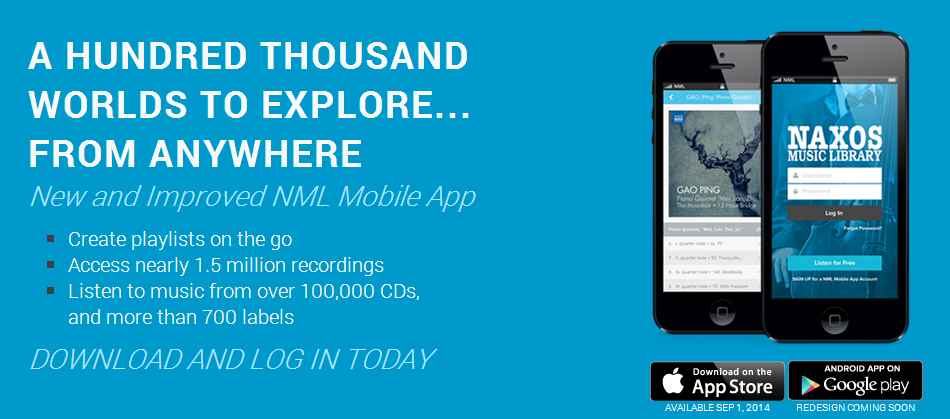
Naxos Music Library is proud and excited to introduce the brand new NML mobile app! Ain't it pretty?

Of course, it's not all about appearance; that would make us shallow, horrible people. The new mobile app comes with greatly improved stability as well, and it boasts cleaner and more logical usability. Further features:
  1. Create a user account on the go! The old process of creating an account from a computer is still available, but now mobile users who are on their school or library's wi-fi can sign up directly from the app. Additionally, if an institution provides users with a mobile access code, it can be used to sign up from anywhere! Find out more here.
  2. Create playlists directly on the app. Previously users could only stream playlists created from a computer, but now they can add any track to any playlist from anywhere.
  3. The player includes improved and expanded controls, including the ability to shuffle, scrub, rewind, or fast-forward through tracks.
If you already have the old mobile app, the new one will be available as an update. If you have not downloaded our mobile app yet, you can easily find it by searching "NML" or "Naxos Music Library" in the app store. At this time, the new app is available for iOS only, but an Android version is expected to follow within a month, and iOS and Android apps for NML-Jazz after that.

Did we mention that the mobile app is still free? Because it is. So download it today, and take 100,000 albums with you in your pocket wherever you go!

How to Access the NML Mobile App

To gain access to the Naxos Music Library app, you will need to create a mobile login. This quick process will connect you with your school or library's specific NML account, which is necessary for letting you access both your institution's and your personal playlists.

If you have ever created your own playlist in NML, then you already have access to the mobile app. Simply log in using the same email address and password you use to reach your playlists. If you have never done this before, there are three ways you can set this up. Don't worry, it should only take a moment.

Option 1: If you are on a desktop or laptop right now, you can access NML as you normally do, then click on the Mobile App link at the top of the page (1). Follow the instructions there (2), and once you click the activation link in the confirmation email (3), you can then use the credentials you just created to sign in to the app.
(1)

(2)

(3)
 

Option 2: If you are on a mobile device and using wi-fi, and if you are on campus or at your library, you can sign up directly in the mobile app through the link at the bottom of the app's front page (1). How do we know which institution to match you up with (2)? Magic! Not really. We just match up the IP address you're using with the institution that claims it. Once you click the link in the activation email (3), you're good to go!
(1)                                                           (2)

 (3)
Option 3: If you are on a mobile device but not on campus or the library premises, after you click the sign-up link on the front page of the app (1) and the app fails to link your IP address with your institution, you will be sent to a screen (2) where you can use a mobile access code that your professor or librarian may have provided to you. It could be in an email they sent out, or in a course syllabus. If you have this, then you can sign up for a mobile account anywhere! The app will use this code to match you up with the right institution. Then you can create your login for the app (3) and activate via email (4). 
(1)                                                            (2)

(3)                                                           (4)
If you do not have an access code, try following option 1 (above) in your mobile browser as though you were on a computer. Some mobile devices and/or browsers can have a little trouble streaming audio, but you can log in this way long enough to sign up for access to the mobile app as you would on a computer.

Note that confirmation emails can sometimes end up in your junk folder, so don't forget to check there if you don't see it in your inbox. In the unlikely event you're unable to find this email in your inbox or junk folder, contact us at NMLHelp@NaxosUSA.com (U.S. and Canada) or Customer.Service@Naxos.com (all other countries) and let us know through which institution you receive access to NML and which email address you used to sign up. We'll get you activated right away.

Once you are signed up and activated, enjoy taking Naxos Music Library with you wherever you go! And make yourself a playlist or two so you can listen to all your favorite recordings in one place. Happy listening!

Wednesday, September 24, 2014

Comment accéder à notre discothèque Naxos avec l’application mobile?


Pour accéder à notre application mobile NML vous avez besoin de créer une connexion mobile. De cette façon vous serez connecté avec votre bibliothèque pour avoir accès à vos listes d’écoute personnalisées (playlist).


Si vous avez déjà créé une liste d’écoute sur NML, alors vous avez déjà un accès à l’application mobile. Il faut simplement vous connecter en utilisant la même adresse de courriel et le même mot de passe que vous utilisez pour accéder aux listes d’écoute.


Option 1:
Si vous êtes avec votre ordinateur ou portable accédez à NML comme d’habitude. Puis cliquez sur la bannière de l’application mobile qui est sur le haut de la page (1). Suivez les instructions (2), et après avoir activé le lien dans le courriel de confirmation (3), vous allez pouvoir utiliser les informations d’accès que vous avez créées pour rentrer dans l’application.
(1)
 

(2)

(3)
 

Option 2:
Si vous utilisez votre portable ou tablette en vous connectant avec le Wi-Fi de votre bibliothèque, vous pouvez vous enregistrer directement dans votre application mobile à travers le lien qui se trouve au-dessous de la page d’accueil (1). Comment sait-on quelle institution est la vôtre? (2) Simplement en validant les adresses IP qui correspondent avec l’institution qui fait la demande. Une fois que vous cliquez sur le lien dans le courriel d’activation, (3) vous êtes prêt pour l’utilisation.
(1)                                                           (2)

 (3)
Option 3:
Si vous utilisez votre portable ou tablette mais que le réseau Wi-Fi n’est pas celui de votre bibliothèque, vous devez vous enregistrer sur le lien de la fenêtre principale de l’application (1).  Après avoir cliqué sur le lien de connexion vers l’application mobile en haut de la page, vous allez être redirigé  vers une autre fenêtre (2)  à partir de laquelle vous allez pouvoir utiliser les codes d’accès que la bibliothèque vous a donné. Ensuite vous pourrez créer votre propre code d’accès pour l’application mobile (3) et l’activer par courriel (4). Si vous n’avez pas de code d’accès, suivez l’option 1 dans votre portable comme si vous étiez sur votre ordinateur. 
(1)                                                            (2)

(3)                                                           (4)